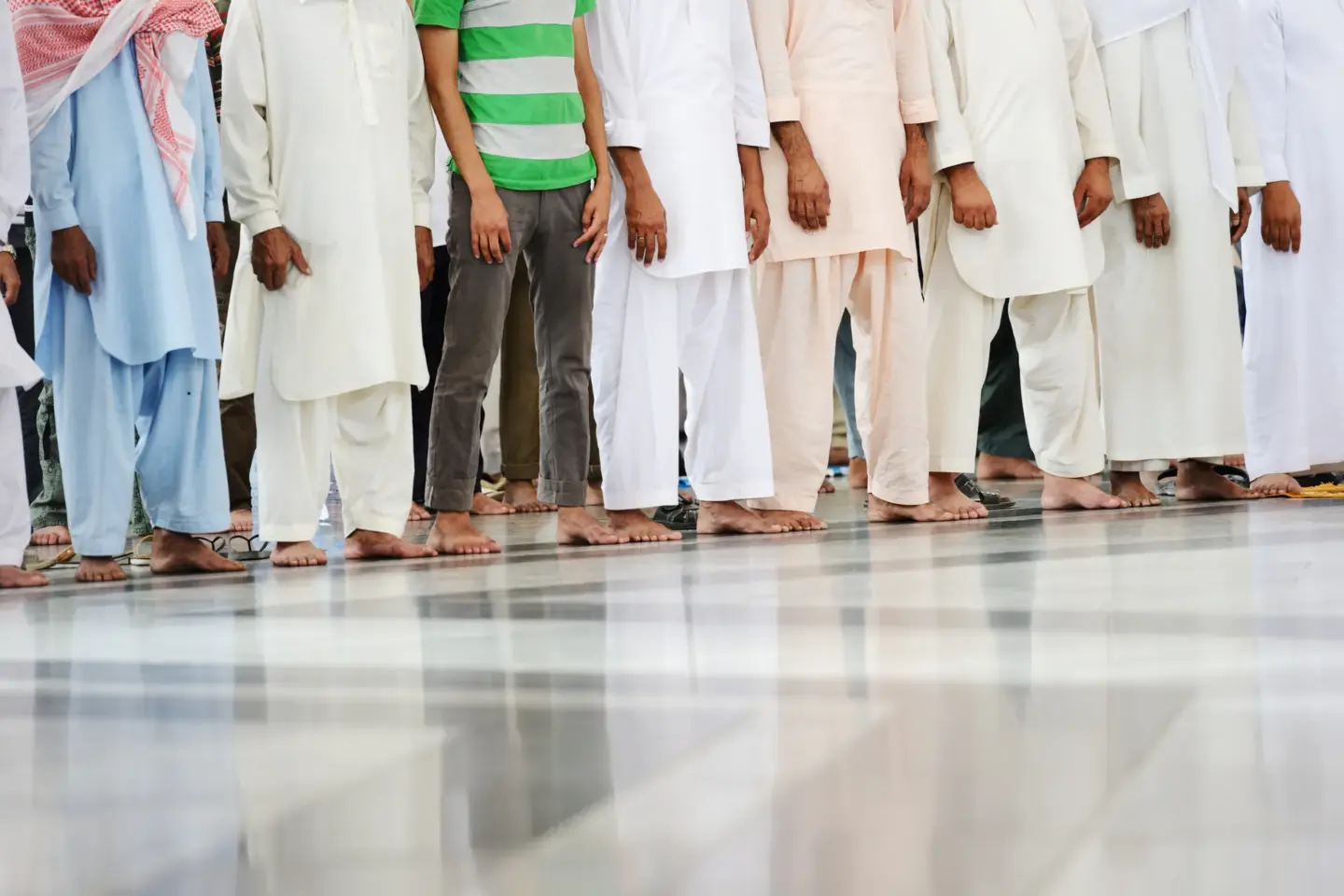

Janazah prayer is the Islamic funeral prayer. You pray it standing only. There is no ruku’ and no sujud. You make four takbirs (Allahu akbar), with recitation, salawat, or dua between them (depending on your madhhab), then you give salam. That is a summary of the whole prayer.
If you opened this because a funeral is today, or you are outside the mosque trying to remember what comes after which takbir, you are in the right place. Below is what all four schools say, taken from classical fiqh books from each madhhab.
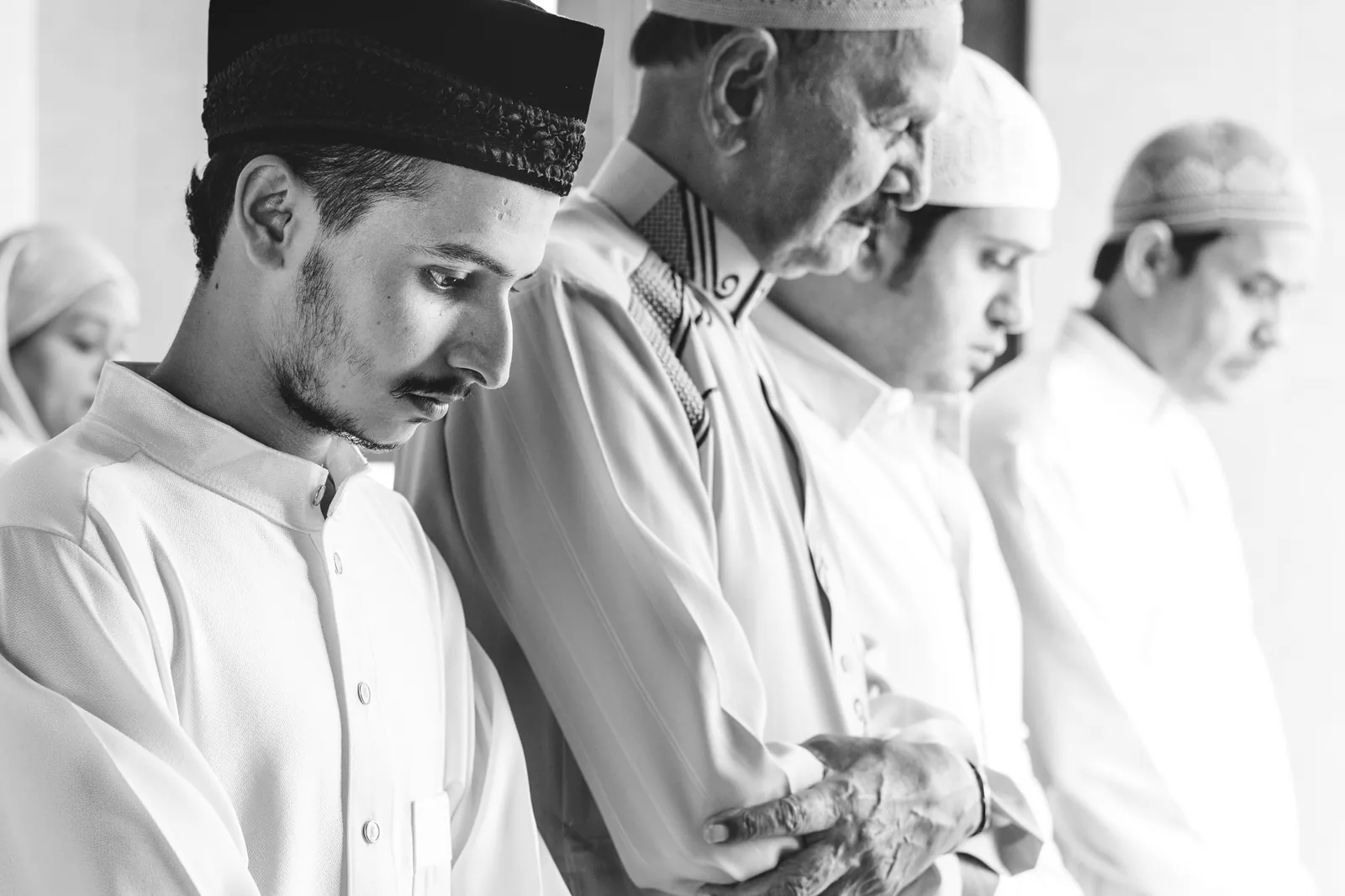
What all four madhhabs share
- Four takbirs.
- Standing if you are able.
- No bowing and no prostration.
- You need purity, covering of the awrah, and facing the qiblah, like in other prayer.
- The reading and dua between the takbirs are quiet, not a loud recitation like Maghrib.
The point is shafa’ah: asking Allah to forgive the dead and show them mercy. The long dua of Awf ibn Malik in Sahih Muslim (963a) is used across the madhhabs when they make dua for the dead:
اللَّهُمَّ اغْفِرْ لَهُ وَارْحَمْهُ وَعَافِهِ وَاعْفُ عَنْهُ، وَأَكْرِمْ نُزُلَهُ، وَوَسِّعْ مُدْخَلَهُ، وَاغْسِلْهُ بِالْمَاءِ وَالثَّلْجِ وَالْبَرَدِ، وَنَقِّهِ مِنَ الْخَطَايَا كَمَا نَقَّيْتَ الثَّوْبَ الْأَبْيَضَ مِنَ الدَّنَسِ، وَأَبْدِلْهُ دَارًا خَيْرًا مِنْ دَارِهِ، وَأَهْلًا خَيْرًا مِنْ أَهْلِهِ وَزَوْجًا خَيْرًا مِنْ زَوْجِهِ، وَأَدْخِلْهُ الْجَنَّةَ وَأَعِذْهُ مِنْ عَذَابِ الْقَبْرِ (أَوْ مِنْ عَذَابِ النَّارِ).
Allahumma ighfir lahu warhamhu wa ‘afihi wa’fu ‘anhu, wa akrim nuzulahu, wa wassi’ madkhalahu, waghsilhu bil-ma’i wath-thalji wal-barad, wa naqqihi min al-khataya kama naqqayta ath-thawba al-abyada min ad-danas, wa abdilhu daran khayran min darihi, wa ahlan khayran min ahlihi wa zawjan khayran min zawjihi, wa adkhilhu al-jannah wa a’idhhu min ‘adhabi al-qabri (aw min ‘adhabi an-nar).
In meaning: O Allah, forgive him and have mercy on him. Keep him safe and pardon him. Honour his resting place and make his entrance spacious. Wash him with water, snow, and hail, and cleanse him of sins as You cleanse a white garment of dirt. Give him a home better than his home, a family better than his family, and a spouse better than his spouse. Enter him into Paradise and protect him from the punishment of the grave (or from the punishment of the Fire).
Sahih Muslim, Hadith 963a
If the deceased is a woman, change the pronouns to the feminine.
Hanafi
According to al-Marghinani in his book al-Hidaya, the prayer is four takbirs: after the first you praise Allah (thana / hamd), after the second you send salawat on the Prophet (peace be upon him), after the third you make dua for yourself, the deceased, and the Muslims, then the fourth takbir and salam. He notes that beginning with thana, then salawat, is the sunnah way of dua, and that if the imam adds a fifth takbir the follower does not go with him. Quran-recitation is not required in the Hanafi janazah. The pillars centre on the takbirs and standing.
- Intention in the heart, then the first takbir. Raise the hands for this opening takbir. After it, say the opening praise (thana), such as Subhanaka Allahumma wa bihamdika…
- Second takbir. Send salawat on the Prophet (peace be upon him).
- Third takbir. Make dua for the deceased (Awf’s dua or another authentic wording).
- Fourth takbir. In the zahir of the madhhab there is no dua after this takbir. Then give two salams.
Additional points
- In the relied-upon Hanafi method, the hands are raised only with the first takbir.
- Jama’ah is sunnah in the madhhab, not a condition of validity.
- Praying janazah inside the mosque is generally disliked (with detail on the degree of karahah and some exceptions in the later books).
Maliki
According to Khalil ibn Ishaq in his Mukhtasar, the pillars of the janazah prayer are the intention, four takbirs, and the dua (and if the imam goes beyond four takbirs, the followers do not wait on the extra). He prefers dua after the fourth as well (wa da’a ba’da al-rabi’ah ‘ala al-mukhtar). One quiet salam ends it, with the imam making it heard by those next to him. There is no Quran reading in the Maliki janazah prayer. Standing if able is assumed with the prayer.
- Intention, then the first takbir.
- Make dua after the takbirs. Dua is a pillar in this madhhab, not an optional extra.
- Continue through four takbirs with dua between them. After each takbir, make dua. According to the position selected by Khalil, dua is also made after the fourth takbir. (Other Maliki authorities differed over the fourth; some did not require it.)
- One salam. The imam says it so those behind can hear.
Additional points
- Jama’ah is sunnah or recommended in the Maliki school, not a condition of validity.
- Praying janazah in the mosque is disliked, as with the Hanafis.
- The heart of the Maliki janazah is dua.

Shafi’i
According to al-Nawawi in his book Minhaj al-Talibin, the pillars include the intention, four takbirs, salam, al-Fatihah after the first takbir (and he notes that Fatiha after a later takbir also suffices), salawat on the Prophet after the second, dua for the dead after the third, and standing if able. He prefers seeking refuge without a long opening du’a, quiet recitation, and raising the hands with the takbirs. No surah is added after al-Fatihah.
- Intention, then the first takbir. Seek refuge from Shaytan, say bismillah, and recite al-Fatihah. Do not add a surah after it.
- Second takbir. Recite the Ibrahimiyyah salawat: Allahumma salli ala Muhammadin wa ala ali Muhammad, kama sallayta ala Ibrahima wa ala ali Ibrahim, innaka hamidun majid. Allahumma barik ala Muhammadin wa ala ali Muhammad, kama barakta ala Ibrahima wa ala ali Ibrahim, innaka hamidun majid.
- Third takbir. Make dua for the deceased.
- Fourth takbir. Make a further short dua (Nawawi gives Allahumma la tahrimna ajrahu wa la taftinna ba’dahu), then give salam. One salam is the required end; a second is sunnah.
Additional points
- Jama’ah is sunnah, not a condition.
- Praying in the mosque is allowed and preferred on the relied-upon view.
- If the imam does a fifth takbir, do not follow that extra takbir. You may wait and give salam with him.
Hanbali
According to Ibn Qudamah in his book al-Mughni, what is required in the janazah prayer is the intention, the takbirs, standing, reciting al-Fatihah, salawat on the Prophet, a minimum dua for the deceased, and one salam. It takes the conditions of the obligatory prayer except the time-window. You do not pray it riding, because that drops the required standing.
- Intention, then the first takbir. Raise the hands, then place them on the chest. Seek refuge, say bismillah, and recite al-Fatihah.
- Second takbir. Raise the hands again, then salawat on the Prophet as in the tashahhud.
- Third takbir. Make dua for this dead person. A general line such as Allahumma ighfir li-hayyina wa mayyitina alone is not enough; the dua must include the deceased, because the point is shafa’ah for this person. Awf’s dua, or Allahumma irhamhu / irhamha, meets that need.
- Fourth takbir. Pause briefly. You may make a short dua according to one Hanbali report, but it is not required. Then give one salam to the right. One salam is the stated sunnah; a second is valid on another report.
Additional points
- Raise the hands with every takbir.
- Four takbirs are the Sunnah and preferred form. In the Hanbali school, additional takbirs transmitted from the early Muslims can be valid, and the follower may follow an imam who gives a fifth. The madhhab does not permit going beyond seven.
- Mosque prayer is allowed if there is no fear of soiling the mosque.
After the prayer
When the prayer finishes, the work for the dead is not finished. If you can follow the burial, there are reports of extra reward (Sahih Muslim 945b). If you cannot stay for the burial, you can still give sadaqah, fund a well in their name, or keep making dua when you remember them.
We have written about the five duas to make when someone dies, and about the three deeds that continue after death. Read those next if you want words for the home and for what lasts beyond the prayer.
And if you want that care to take a concrete form, give sadaqah jariyah through As-Salaam in their name.
The janazah prayer may last only a few minutes, but your benefit to the deceased does not have to end at the grave. Keep making dua for them, give charity on their behalf, and if you establish something lasting such as a well or another form of sadaqah jariyah, its benefit can continue long after the burial.